
Obesity & the immune system
Seven of the top 10 leading causes of death and disability in the U.S. today are chronic diseases such as cancer and diabetes.1 Prevention and treatment of most of these conditions must address the close link with obesity. People who are overweight or obese account for more than two-thirds of the U.S. population.1,2 Management of overweight (BMI ≥ 25 kg/m2) or obesity (BMI ≥ 30 kg/m2) in the clinical setting – alone or in combination with a chronic disease – is, and should continue to be a critical focus in public health.
Increasingly, obesity is recognized as a perpetual state of chronic low-grade inflammation.3 In obesity, an altered network of adipokine and cytokine interactions contributes to impaired adipocyte metabolism.4,5 Obese people display increased levels of circulating cytokines, which can induce innate immune responses and influence the expression of several inflammatory mediators. As low-grade inflammation is involved in the pathophysiology of obesity, circulating cytokines are being identified as potential therapeutic targets for obesity treatment.
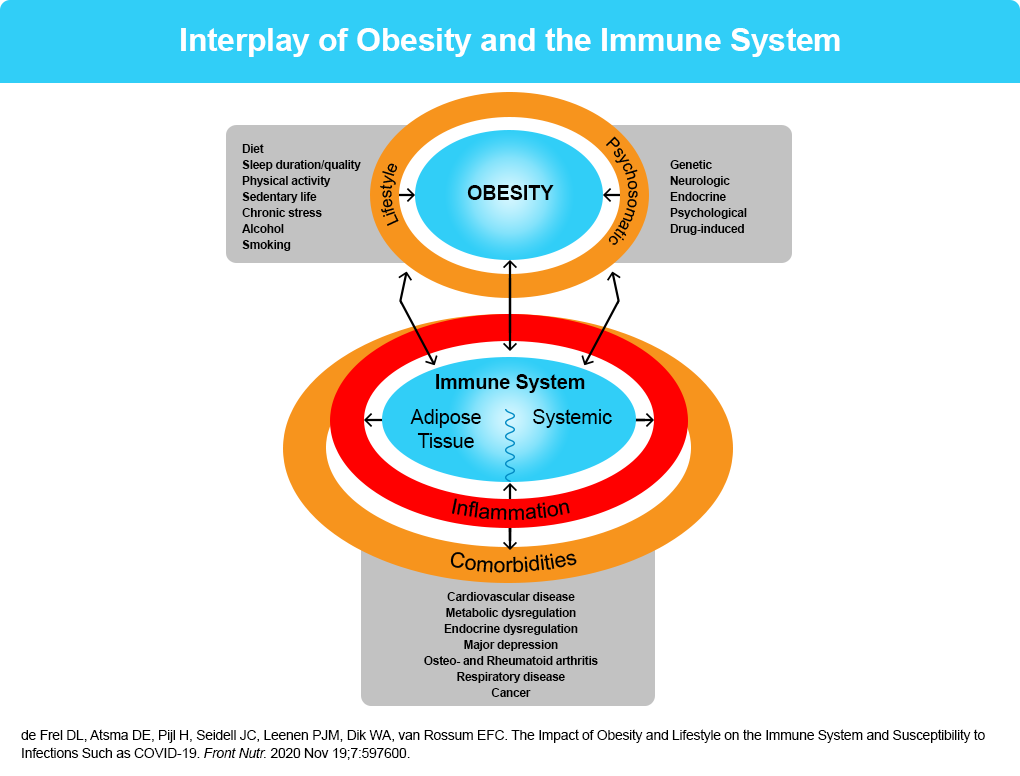
In obesity, increased plasma levels of free fatty acids and cytokines, intracellular non-adipose tissue lipids, and ectopic adipose tissue deposits can contribute to systemic inflammation, insulin resistance, and overactivity of the sympathetic nervous system.6 Adipose tissue, made up of adipocytes, functions as a metabolically active endocrine organ that releases inflammatory adipokines and other pro-inflammatory mediators.7 Adipokines have diverse physiological functions, including regulation of the immune system and inflammatory response.8,9
Leptin is one example of an adipokine that promotes the expression of pro-inflammatory cytokines (e.g., IL-1α, IL-12, TNFα, IL-17, and IL-6) and suppresses anti-inflammatory cytokines (e.g., transforming growth factor [TGF]-β and IL-10).10 Lower levels of adiponectin (an anti-inflammatory adipokine) and higher levels of leptin have been reported in patients with inflammatory disease compared with those without.11 Consequently, the low-grade, chronic inflammatory state created by obesity has led to growing understanding of its relationship as a precursor to immune-mediated inflammatory disorders (IMIDs) such as psoriasis, psoriatic arthritis, and inflammatory bowel disorder. Thus, managing obesity is a critical element of IMID treatment.
References
- US Department of Health and Human Services. Health, United States, 2015. National Center for Health Statistics, 2016:461.
- Stecker T, Sparks S. Obesity (Silver Spring). 2006;14: 373-376.
- Winer D, et al. Cell Metab. 2016;23:413–426.
- Olefsky J, Glass C. Annu Rev Physiol. 2010;72:219–246.
- de Frel DL, et al. Front Nutr. 2020;7:597-600.
- Gadde K, et al. J Am Coll Cardiol. 2018;71:69-84.
- Caso F, Chimenti M. Expert Rev Clin Immunol. 2020;16:409–420.
- Toussirot E, et al. Front Immunol. 2022;13:970371.
- Hauner H. Proc Nutr Soc. 2005;64:163–169.
- Lord GM, et al. Nature. 1998;394:897–901.
- Wang Y, et al. Br J Dermatol. 2008;158:1134–1135.